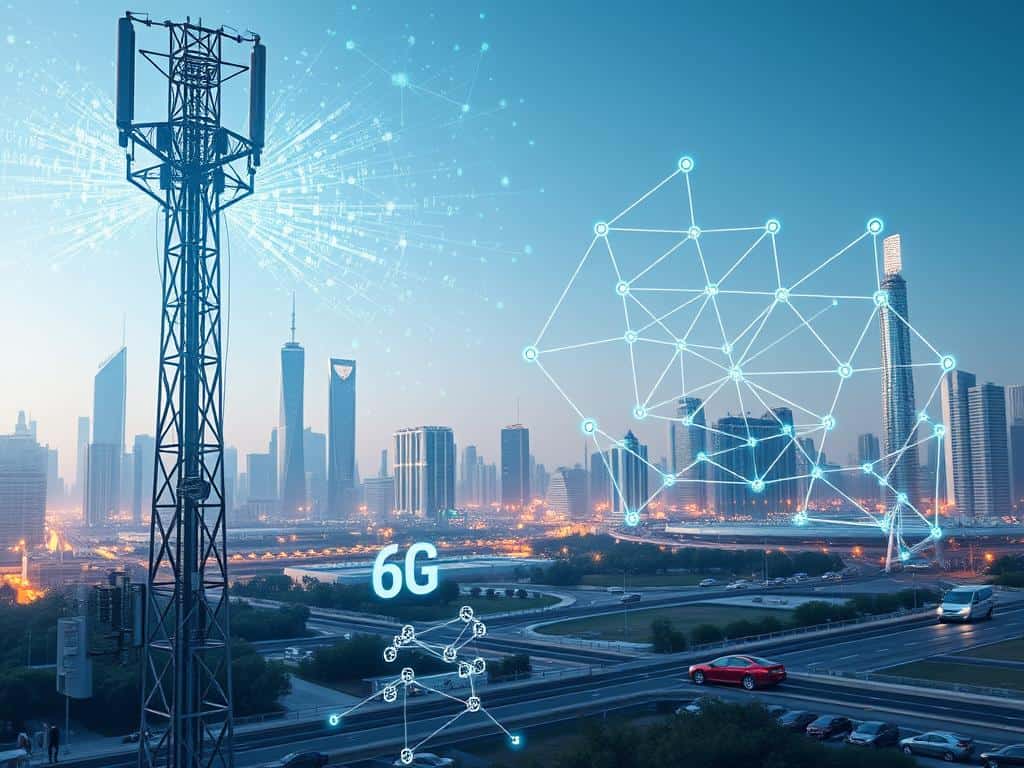
Did you know 6G technology could make data transfer speeds up to 100 times faster than 5G by 2030? This is not just about faster internet. It’s a big change in how we connect and talk to each other. As we get ready for this new wireless technology, excitement about 6G is growing. I’m excited to tell you how this future tech will change our world with new network ideas.
Research is already starting to build 6G networks. It promises fast data transfer and better machine-to-machine connections. But, this big change also brings challenges like high costs and security worries. We need to think about these carefully as we move ahead.
Key Takeaways
- 6G technology will surpass 5G in speed and efficiency.
- Anticipated rollout of 6G networks is aimed for 2030.
- Innovative features include the use of terahertz frequencies.
- Instantaneous data transfer will enhance connectivity.
- Careful planning is needed to address infrastructure and security challenges.
- 6G will foster greater machine-to-machine communication.
- This evolution marks a significant shift in how we interact with technology.
What Is 6G Technology?
The 6G network is set to change wireless communication forever. As I dive into this new tech, it’s clear how big its impact will be. It uses ultra-high radio frequencies for faster data speeds than ever before.
This change could completely transform how we stay connected.
Overview of 6G Technology
The 6G network is expected to be much faster than 5G, with speeds over 1 terabyte per second. This is about 1,000 times quicker than what we have now. It aims to make latency almost non-existent, making services almost instant.
Artificial intelligence (AI) plays a key role in 6G. It helps the network adjust and respond quickly to new needs and situations.
Key Features of 6G Technology
One of 6G’s standout features is its ability to connect millions of devices smoothly. This is vital for the Internet of Things (IoT). It also supports smart devices and applications, like self-driving cars and smart factories.
With 6G, we can expect amazing experiences. Imagine virtual reality concerts or remote surgeries with real touch feedback. Ultra-high radio frequencies are the backbone of these incredible advancements.

Differences Between 5G and 6G
The move from 5G to 6G is a big step forward in how we talk to each other. It’s exciting to look at how these changes affect speed, latency, coverage, and how well we can communicate. This change will impact many areas of life and work.
Speed and Latency
5G networks are fast, reaching speeds of about 20 gigabits per second. They also have a low latency of 1 millisecond. On the other hand, 6G aims to go even faster, over 100 gigabits per second. It also wants to cut down latency to less than 0.1 milliseconds.
These big improvements will change how machines talk to each other. They will also make our experiences better in many areas.
Coverage and Efficiency
Looking at coverage and how well we can communicate, 6G is promising. It plans to use higher frequency bands to cover more area. 5G can handle up to 100,000 devices per square kilometer.
But 6G could support an amazing 10 million devices per square kilometer. This will make our connections more reliable. It will also open up new possibilities for applications that need fast, real-time communication.
Conclusion
As we look to the future, 6G is set to change our digital world. It’s not just an update; it’s a big leap forward. I’m excited to see how it will make our lives better, from smart cities to better healthcare.
But, we also face big challenges. Building new infrastructure will cost a lot, and we need to keep our data safe. It’s important to make sure everyone can use these new technologies. We must find a way to use 6G wisely and protect our digital world.
In the end, 6G’s future looks bright, but we must be careful. We need to make sure everyone can enjoy its benefits. I’m looking forward to seeing how this new technology changes our world.
